

Overview & History
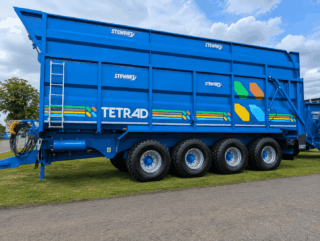
Stewart Trailers is a Scottish agricultural trailer manufacturer specialised in high-specification tipping trailers, construction trailers, low loaders, livestock trailers, flat trailers, and road-transport solutions for agriculture and contracting businesses. The company is headquartered in Daviot, near Inverurie, Aberdeenshire, Scotland, and has established itself as one of the most recognised premium trailer manufacturers in the United Kingdom. Founded in 1988, the company remains independently owned and managed by James and Mandy Stewart.
The company emerged during a period when British agriculture was becoming increasingly mechanised and transport-intensive. Larger harvesting equipment, higher crop volumes, and growing contractor businesses created demand for stronger and safer trailer platforms capable of operating efficiently both in the field and on public roads. Stewart positioned itself in this environment by focusing on build quality, durability, and engineering robustness rather than competing solely on price.
Over the following decades, Stewart expanded from a regional manufacturer into a nationally recognised brand with distribution throughout the UK and selected export markets. The company progressively developed specialised trailer platforms designed to meet increasingly demanding transport regulations while addressing the operational requirements of modern farming and contracting businesses. Today, Stewart occupies a premium niche within the agricultural transport segment and is widely associated with heavy-duty, road-capable trailer systems.
Unlike tractor or implement manufacturers, Stewart’s expertise is concentrated on the transport layer of the agricultural machinery ecosystem. Its products play a critical role in moving crops, inputs, machinery, and livestock between field, farm, and market.
Corporate Structure / Ownership
Stewart Trailers operates through Stewart Agricultural Limited, a privately held company based in Aberdeenshire, Scotland. The business remains family-owned and managed by founders James and Mandy Stewart, preserving a strong independent identity despite operating in a market increasingly characterised by consolidation.
The organisation integrates:
- trailer engineering
- fabrication
- welding
- assembly
- product development
- parts support
- dealer management
- customer service
Unlike diversified machinery groups, Stewart focuses almost exclusively on trailer manufacturing. It does not produce tractors, implements, harvesting equipment, or precision-agriculture technologies.
This concentrated business model allows engineering resources to remain focused on transport equipment and trailer innovation.
Core Business & Product Portfolio
Stewart’s core business is the design and manufacture of agricultural and construction trailers.
GX Tipping Trailer Series
The GX Series represents the company’s flagship agricultural trailer range.
Applications include:
- grain transport
- silage transport
- root crop logistics
- contractor operations
- bulk material handling
The GX range covers multiple capacities and specifications, targeting both farms and professional contracting businesses.
PRO Series Trailers
The PRO Series is positioned at the premium end of the portfolio.
Key features include:
- Hardox steel bodies
- heavy-duty construction
- enhanced durability
- high-capacity transport capability
These trailers are designed for intensive usage environments where wear resistance and structural longevity are critical.
Road King Series
The Road King range reflects Stewart’s strong emphasis on transport efficiency and road safety.
The series was developed specifically to address evolving UK transport legislation and increasing expectations around agricultural vehicle roadworthiness.
Applications include:
- long-distance crop transport
- contractor fleets
- high-speed agricultural transport
The platform targets users who operate extensively on public roads as well as in-field environments.
Flat Trailers
Stewart manufactures a range of flatbed transport solutions for:
- machinery transport
- bale handling
- palletised goods
- general farm logistics
The emphasis is on structural strength and operational versatility.
Low Loader Trailers
The low-loader segment serves customers requiring movement of:
- tractors
- telehandlers
- construction equipment
- specialist machinery
These products extend Stewart’s presence beyond agriculture into construction and industrial applications.
Livestock Transport Equipment
The company also manufactures livestock trailer bodies designed for:
- cattle transport
- sheep transport
- livestock logistics
This segment supports mixed-farming and livestock operations throughout the UK.
Product Scope Clarification
Stewart does not manufacture:
- tractors
- combines
- sprayers
- seed drills
- tillage equipment
- harvesting machinery
Its expertise remains concentrated on transport and logistics equipment.
Technology & Engineering / Digital Approach
Stewart’s engineering philosophy is based on:
durability + transport safety + operational efficiency
Unlike many agricultural machinery manufacturers, Stewart’s primary engineering challenge is not field performance but transport performance under demanding conditions.
Key engineering priorities include:
- chassis strength
- stability
- payload optimisation
- braking performance
- road safety
- operator reliability
The company offers a range of advanced trailer technologies including:
- air braking systems
- ABS braking systems
- load sensing valves
- central tyre inflation systems
- hydraulic suspension
- air suspension
- onboard weighing systems
- automatic lubrication systems
- powered steering systems
These features position Stewart at the premium end of the agricultural trailer market.
Digitalisation is focused primarily on transport management and load-monitoring technologies rather than autonomous or precision-agriculture systems.
Positioning:
Premium agricultural transport and logistics platform
Manufacturing & Industrial Footprint
Manufacturing is concentrated at the company’s facility in Daviot, Aberdeenshire, Scotland.
The site integrates:
- design engineering
- fabrication
- welding
- assembly
- finishing
- quality control
Stewart maintains direct control over production processes to ensure consistency and product quality. The facility serves both domestic and export markets through a network of appointed agents and distributors.
The industrial model is characterised by relatively low-volume, high-value manufacturing rather than mass production.
Markets & Distribution / Customer Base
Customer Segments
Stewart primarily serves:
- large farms
- agricultural contractors
- livestock enterprises
- machinery transport businesses
- construction contractors
Its strongest position is among professional users who place high value on trailer durability and road performance.
Geographic Presence
The company’s primary market is the United Kingdom.
However, Stewart also exports through appointed distributors and dealer networks into selected international markets. Its strongest presence remains within:
- Scotland
- England
- Wales
- Northern Ireland
with growing visibility in overseas agricultural markets.
The expansion strategy is focused on regions where professional contracting and high-capacity transport operations are common.
Strengths & Competitive Advantages
Key strengths include:
- strong brand reputation in the UK
- premium build quality
- extensive transport expertise
- family ownership stability
- broad trailer portfolio
- advanced road-safety technologies
- customisation capability
A particularly important advantage is the company’s focus on transport engineering. While many agricultural manufacturers treat trailers as secondary products, Stewart’s entire business is centred on transport optimisation and durability.
The company also benefits from strong customer loyalty among professional contractors.
Weaknesses / Constraints
Structural limitations include:
- concentration in a single machinery category
- limited scale compared with multinational manufacturers
- dependence on agricultural investment cycles
- relatively limited international footprint
Compared with large OEMs, Stewart lacks:
- global manufacturing facilities
- diversified product categories
- integrated digital farming ecosystems
- captive financing operations
Its growth remains tied to the agricultural and construction transport sectors.
Outlook & Opportunities
Stewart is positioned around several structural trends:
- increasing farm scale
- growth of agricultural contracting
- higher transport volumes
- stricter transport regulations
- demand for safer road transport
Key opportunities include:
- export expansion
- advanced trailer telematics
- further integration of weighing technologies
- transport efficiency solutions
- growth in contractor fleets
As agricultural machinery becomes larger and harvest logistics become more complex, transport systems are becoming increasingly important within farm operations. This trend directly supports Stewart’s long-term market relevance.
Summary Table
| Category | Highlights |
|---|---|
| Name | Stewart Trailers (Stewart Agricultural Limited) |
| Headquarters | Daviot, Inverurie, Aberdeenshire, Scotland |
| Core Business | Agricultural and construction trailers |
| Product Range | Tipping trailers, low loaders, flat trailers, livestock trailers |
| Technology Focus | Transport efficiency, braking systems, trailer safety |
| Strengths | Build quality, road performance, contractor reputation |
| Weaknesses | Narrow product focus, limited international scale |
| Primary Markets | United Kingdom and selected export markets |
| Positioning | Premium agricultural transport equipment manufacturer |
Bottom Line
Stewart Trailers is one of the UK’s most specialised and respected agricultural transport manufacturers. Rather than competing across multiple machinery categories, the company focuses entirely on trailers and transport systems, allowing it to develop deep expertise in a critical but often overlooked area of agricultural mechanisation.
Its strategic importance lies in the logistics layer of the farming ecosystem. As farms become larger, harvest windows become tighter, and transport regulations become more demanding, the ability to move crops, machinery, and livestock efficiently becomes increasingly valuable. Stewart has built its reputation by addressing precisely this challenge through premium engineering, durability, and transport-focused innovation.