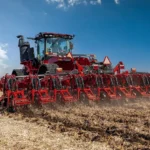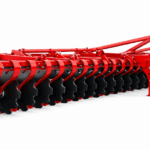


Case IH is expanding its soil management portfolio with the Nutri-Tiller 1000 series, a strip-till solution designed to combine the agronomic benefits of no-till with the soil conditioning advantages of conventional tillage. The launch reflects a growing industry focus on balancing productivity with long-term soil health, particularly in high-efficiency row crop systems.
At the core of the concept is the creation of a uniform strip with an optimized berm profile, enabling earlier soil warming and more consistent moisture conditions at planting—key factors for fast and uniform crop emergence. By minimizing soil disturbance between rows while actively conditioning the seed zone, the system aims to reduce compaction, preserve residue, and improve nutrient utilization.
From a technology standpoint, the Nutri-Tiller 1000 integrates full in-cab control of critical parameters such as residue management, downforce, and berm shaping, allowing operators to adjust settings in real time without stopping. The system is also fully connected through Case IH FieldOps and Active Implement Guidance, enabling precise alignment between strip-till and planting operations while optimizing input placement.
More broadly, the product reflects a shift toward fewer passes, lower input costs, and tighter integration between soil preparation and planting.
Bottom line
The Nutri-Tiller 1000 positions strip-till as a “middle ground” solution, combining conservation and productivity in a single pass. The strategic implication is clear: future competitiveness in tillage will not be about eliminating soil work, but optimizing it.
As precision farming evolves, the integration between tillage, planting, and data layers becomes critical. In this context, tools like the Nutri-Tiller 1000 are less about mechanics and more about system efficiency—where soil health, input optimization, and operational productivity converge.