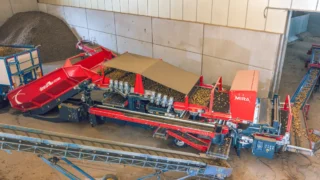


Belgian agricultural machinery manufacturer Dewulf has introduced the MIRA optical potato sorter, a new in-house-developed system designed to automate the removal of stones and soil clods during potato handling and storage operations. Scheduled for presentation at Interpom 2026 in Kortrijk, Belgium, from November 29 to December 1, the machine combines camera-based recognition with artificial intelligence to identify unwanted materials in the crop flow. The development addresses the increasing operational challenges associated with variable harvesting conditions, particularly when wet soils or prolonged dry periods increase the presence of clods and other impurities.
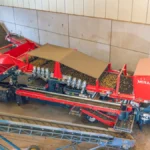
The MIRA features a 2.4-metre-wide sorting unit that can operate independently or be integrated with an existing receiving hopper. Potatoes are transported across a flat hedgehog belt designed to stabilise the product flow before passing through the optical inspection area. Cameras capture images of individual objects, while AI-based software distinguishes potatoes from stones and soil clods. Unwanted materials are subsequently removed through mechanically actuated ejector fingers. According to Dewulf, processing capacity ranges from 50 to 120 tonnes per hour, depending on the quantity of foreign material entering the system.
The introduction reinforces Dewulf’s investment in automated crop handling and post-harvest technologies. Optical sorting offers potato growers and storage operators opportunities to reduce manual intervention, improve product flow consistency and limit the transfer of unwanted materials into storage facilities. Dewulf previously presented the MG 240 optical sorter in 2024, making the MIRA part of an evolving technological offering rather than the company’s first entry into this segment. Its commercial value will depend on sorting accuracy, throughput under variable field conditions, integration costs and the ability to minimise unnecessary rejection of marketable potatoes.
Bottom Line
Dewulf’s MIRA highlights the expanding role of AI-based machine vision in agricultural equipment beyond field operations. For manufacturers of harvesting and storage machinery, automated crop handling is becoming an increasingly important area of product differentiation and potential customer value.
To dive deeper and photo source: https://www.terrefermiere.be/recolte-et-stockage/dewulf_mira/