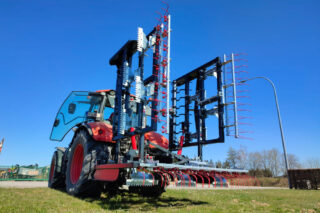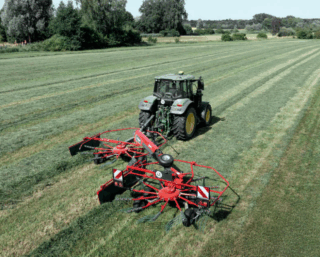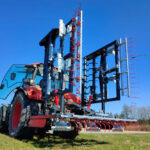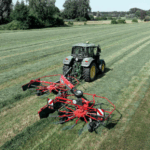


Pöttinger is positioning the Mergento VT 9220 as a new-generation belt rake designed to improve forage quality by fundamentally changing how crop is handled during raking. Unlike traditional rotary rakes, the machine uses a pick-up and conveyor belt system to lift and transport forage without dragging it along the ground, minimizing contamination and preserving nutritional value.
With a working width of up to 9.2 meters (central swath), the semi-mounted unit targets high-capacity operations while maintaining flexibility in swath placement—central, side, or dual—depending on field conditions and harvesting strategy. The system is built around two pick-up units (3.7 m each) feeding cross conveyor belts, ensuring a continuous and controlled crop flow even in short or uneven material.
A key differentiator is the gentle crop handling: forage is lifted and transferred onto the belts without ground contact, reducing leaf loss and ash contamination—critical for high-quality silage and hay production. The machine also features full in-cab control of belt direction and swath formation, enabling operators to adapt quickly to field layout and harvesting logistics.
Overall, the Mergento VT 9220 reflects a shift from mechanical raking toward controlled crop flow systems designed to preserve value rather than simply move material.
Bottom line
By eliminating ground contact and controlling crop flow through conveyor technology, Pöttinger is redefining the role of the rake from a gathering tool to a quality-preservation system.
The implication is clear: in modern forage systems, nutritional value and contamination levels are becoming as important as output. Equipment that protects crop integrity—especially in leafy and high-value forage—will increasingly define competitiveness in the harvesting chain.