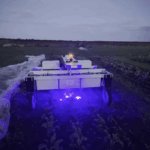

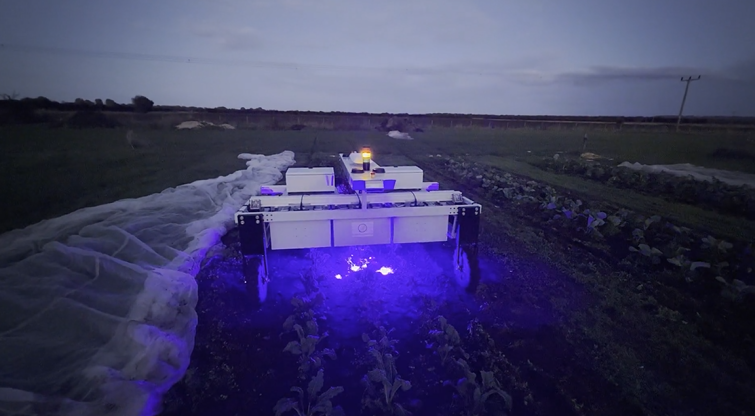
British agricultural robotics company Earth Rover is advancing the commercial rollout of its CLAWS autonomous weeding robot, having sold its first 10 pilot-production units with another 15 machines currently under construction for customers. The development marks an important step in the company’s transition from technology validation to early market adoption. Designed primarily for vegetable and horticultural operations, CLAWS (Concentrated Light Autonomous Weeding and Scouting) combines non-chemical weed control with automated crop monitoring, addressing growing demand for alternatives to conventional herbicides and labor-intensive field operations.
Unlike robotic weeders relying on lasers, mechanical cultivation or precision spraying, CLAWS uses short pulses of concentrated light to destroy weeds by targeting their growing points. Cameras and artificial intelligence distinguish crops from unwanted vegetation, allowing the robot to operate close to cultivated plants without disturbing the soil. The lightweight platform is powered by batteries supported by solar panels and can operate for up to 16 hours without a battery change. Its adjustable track width ranges from 1.5 to 2 metres, while integrated imaging systems collect information on plant populations and crop development. With an indicative purchase price of approximately £150,000, Earth Rover estimates a potential investment payback of one to three years, depending on farm operating conditions and existing weed-control costs.
The initial commercial deployment represents a significant milestone for Earth Rover as it seeks to establish concentrated-light treatment as a viable alternative within the expanding agricultural robotics market. The company is initially targeting vegetable and salad producers, where high labor requirements, herbicide resistance and increasingly restricted chemical options create demand for automated solutions. Beyond weed removal, the integration of crop scouting and plant-level data collection could strengthen the economic proposition by allowing a single autonomous platform to perform multiple agricultural functions. Earth Rover is also considering expansion into broadacre crops and plans to pursue additional investment in 2027 to support further industrial and commercial development.
Bottom Line
Earth Rover’s first commercial CLAWS sales demonstrate growing interest in non-chemical robotic weed control and represent an important step towards broader market adoption of concentrated-light technology. The combination of autonomous operation, selective weed treatment and crop intelligence offers a differentiated approach, although large-scale competitiveness will ultimately depend on independently demonstrated field productivity, operating costs and reliability across different agricultural conditions.