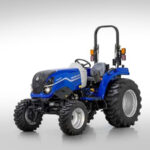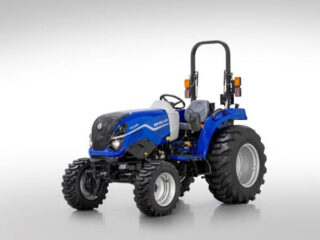

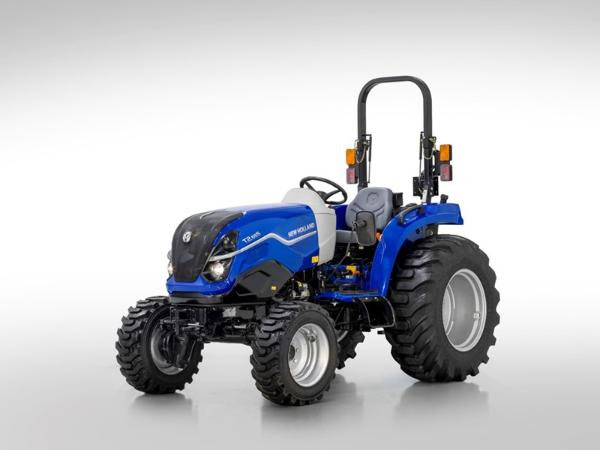
New Holland has introduced the new T2S compact tractor series ahead of EIMA International 2026, expanding its European portfolio with five models ranging from 35 to 57 hp. The T2.35S, T2.40S, T2.45S, T2.50S and T2.55S are designed for applications extending from livestock farming and horticulture to property maintenance and municipal operations. Powered by three-cylinder, 1.9-litre engines, the tractors combine compact dimensions with a choice of mechanical or hydrostatic transmissions, addressing customers who require versatile machines for both agricultural and non-agricultural tasks.
The T2S range offers a 12×12 synchronized shuttle transmission or a three-speed hydrostatic alternative, with an optional servo-assisted hydrostatic configuration intended to reduce operator effort during repetitive loader operations. Rear linkage capacity reaches 950 kg in Category 2 configuration and 1,315 kg in Category 3 configuration. New Holland has also redesigned the operator platform, introducing improved access, suspended pedals and revised instrumentation. An important development is the connectivity-ready architecture across all five models: an optional CM1X modem enables integration with the FieldOps digital platform, supporting remote machine monitoring and, with customer authorization, dealer access to operating information for service assistance.
The new series will be displayed at EIMA International 2026, with orders scheduled to open through New Holland dealers in early 2027. Beyond the mechanical specifications, the launch reflects a broader effort to bring connected-machine capabilities into smaller equipment categories, where digital services have traditionally been less prominent than in high-horsepower agricultural machinery. By combining implement versatility, operator comfort and connectivity, New Holland is strengthening its position in a compact tractor segment serving a diverse customer base and multiple applications.
Bottom Line
The T2S launch extends New Holland’s compact tractor offering while introducing connectivity-ready architecture across the entire five-model range. Its strategic significance lies not only in the additional horsepower and implement capabilities, but also in the potential to expand digital monitoring and dealer-supported services into smaller agricultural machines.