

Overview & History
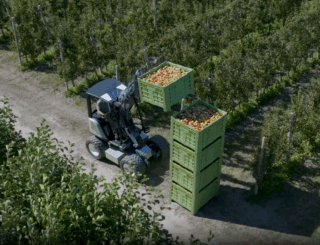
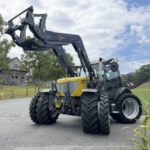
Huson/Hudson Dynamics is a Dutch equipment technology company developing a highly unconventional battery-electric multifunctional machine platform intended to combine the capabilities of several compact machines—including a tractor, wheel loader, skid steer, forklift and compact excavator—within a single vehicle.
The technology was originally developed under Hudson Dynamics, while the commercial machine and current market identity are presented as HUSON™ through Huson International B.V., based in Goes, Zeeland, Netherlands. The company describes its team as bringing together more than 50 years of combined experience in equipment and electric vehicles.
Rather than electrifying an existing tractor or loader architecture, Hudson Dynamics has developed the machine around an entirely new concept: a compact electric chassis supporting a 360° rotating cab and multifunctional robotic boom, four-wheel steering, four-wheel drive and multiple attachment interfaces.
The project remains in the pre-series / industrialisation phase. As of 2026, HUSON states that prototype testing is ongoing and that specifications of the final production machine may differ from the current prototype.
Corporate Structure / Ownership
The commercial entity behind the machine is Huson International B.V., headquartered at:
Goes, Zeeland, Netherlands
The underlying R&D organisation is associated with Hudson Dynamics, which continues to appear in publicly funded technology-development programmes.
The company’s activities encompass:
- mechanical engineering
- electrical engineering
- mechatronics
- robotics
- machine software
- electric powertrains
- hydraulic systems
- machine-control systems
- prototype development
- production engineering.
Hudson Dynamics is also participating in an OPZuid project, co-funded by the European Regional Development Fund, the Dutch government and the Province of Zeeland. The project focuses on taking the multifunctional electric platform and its high-force intelligent robotic arm from TRL 6 toward TRL 8. Partners include University College Roosevelt, Hydrauvision, Kloosterman and Sandee.
Core Business & Product Portfolio
HUSON currently revolves around one modular machine platform rather than a conventional multi-model product portfolio.
Its defining concept is:
One power platform → multiple machine functions.
Off-Road Forklift
HUSON can operate as a compact off-road forklift.
The robotic vertical-lift system provides:
- more than 3 m fork height
- vertical/semi-vertical lift path
- four-wheel drive
- four-wheel steering
- differential locks
- off-road capability.
Keeping the load close to the machine during lifting is intended to improve stability.
360° Loader
The same platform can operate as a 360° rotating wheel loader.
Unlike a conventional loader, the entire upper structure can rotate, allowing the operator to load and discharge material without repeatedly repositioning the chassis.
Features include:
- 360° rotation
- automatic return-to-load
- semi-vertical lift geometry
- central operator position
- loader/skid-steer attachment compatibility.
360° Articulated Boom
HUSON can also operate in an excavator/handler configuration through a three-segment articulated boom.
The system provides:
- 360° rotation
- excavation capability
- lifting capability
- lateral offset
- craning applications
- proportional hydraulic circuits
- tilt-rotator compatibility.
Applications include handling stones, logs, trees and branches as well as excavation and landscape work.
Tractor Configuration
Agriculture becomes particularly relevant through the tractor configuration.
HUSON supports Category 1 and Category 2 three-point hitch widths, enabling conventional tractor implements to be attached to the machine.
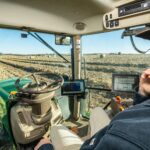
The operator can rotate the cab to obtain the most appropriate working position, while reverse steering allows the machine to operate effectively in either direction.
Importantly, the three-point hitch and 360° boom can operate independently.
This creates unusual combinations such as:
tractor implement + robotic boom simultaneously.
Off-Road Power Station
HUSON can additionally function as a mobile electrical power source.
The battery system can supply:
- 230 V tools
- electric handheld equipment
- rechargeable equipment
- field/worksite electrical loads.
The machine therefore becomes both a mobile power unit and a working machine.
Attachments
HUSON states that more than 200 standard tools can potentially be connected to the platform.
Compatibility includes tools traditionally associated with:
- tractors
- skid steers
- wheel loaders
- excavators
- forklifts.
This attachment interoperability is central to the business proposition.
Product Scope Clarification
HUSON develops:
- battery-electric multifunctional machines
- compact tractor/tool-carrier functionality
- 360° loaders
- off-road forklift functionality
- excavator/boom functionality
- robotic lifting systems
- mobile electric power capability
- attachment interfaces
- machine-control software.
HUSON does NOT currently manufacture a conventional range of:
- agricultural tractors
- combines
- forage harvesters
- sprayers
- seed drills
- balers
- telehandlers
- agricultural implements
- engines.
Its industrial focus is best described as multifunctional zero-emission compact equipment.
Technology & Engineering / Digital Approach
HUSON’s technological architecture is substantially more sophisticated than that of a conventional compact tractor.
Its philosophy can be summarised as:
Electrification + multifunctionality + robotics + high machine utilisation.
Ground-Up Electric Architecture
HUSON has been designed as an electric machine from inception rather than converting a diesel chassis.
Batteries are integrated into both the lower main frame and rotating upper structure, helping create:
- low centre of gravity
- counterweight functionality
- efficient packaging
- improved stability.
The company targets up to 10 hours of normal working operation from a full charge.
Charging supports European:
- 230 V single phase
- 230 V two/three phase
- public Type 2 EV charging.
Overnight charging from a conventional 230 V socket is also envisaged.
Electric Performance
The company states that combined peak electric power can reach approximately twice that of similarly sized diesel compact machines, although final production specifications have not yet been published.
Four-wheel drive and four-wheel steering are standard architectural elements, with both axle differentials capable of 100% locking.
Digitally Controlled Hydraulics
All hydraulic functions are digitally controlled.
The architecture includes:
- proportional auxiliary circuits
- digital joystick control
- touchscreen work-mode selection
- configurable hydraulic settings
- different joystick mappings according to operating mode.
This allows the operator interface to change depending on whether HUSON is functioning as an excavator, loader, tractor or another machine type.
Robotics & Intellectual Property
One of the strongest assets of the project is its intellectual-property portfolio.
HUSON reports worldwide granted and pending patents and registered design rights covering areas including:
- 360° robotic lift
- robotic vertical lift
- articulated machine configurations
- battery packaging
- electric powertrain configurations
- energy recovery
- electric-hydraulic architectures
- tractor attachment compatibility
- robotic movement control
- CAN-bus systems
- human-machine interfaces
- safety systems
- software
- hydrogen powertrain configurations.
This suggests that Hudson Dynamics’ strategic value lies not simply in producing a compact electric machine but in developing a protected multifunctional machine architecture.
Manufacturing & Industrial Footprint
HUSON is being developed and assembled in Zeeland, southwestern Netherlands.
The company intends to use European suppliers wherever possible and emphasises short supply chains and European manufacturing.
The industrial model is currently transitioning from prototype development toward series production.
Rather than immediately building a global factory network, the company plans progressive regional industrialisation and ultimately states an ambition to assemble machines with zero emissions on continents where customer volumes justify local production.
Markets & Distribution / Customer Base
HUSON targets considerably more than agriculture.
Potential customers include:
- farms
- livestock operations
- landscaping contractors
- municipalities
- construction companies
- forestry operators
- property-maintenance businesses
- infrastructure contractors
- specialist outdoor operators.
The company has defined a four-stage commercial rollout:
Phase 1: selected customers in Zeeland
Phase 2: selected Northwest European markets
Phase 3: broader European expansion
Phase 4: markets outside Europe.
Initially, sales and service will be handled directly by HUSON in Zeeland, followed by partnerships with external service organisations as geographic coverage expands.
Sustainability Approach
Sustainability is integral to the machine architecture rather than simply a powertrain option.
HUSON combines:
- zero local exhaust emissions
- electric propulsion
- regenerative/energy-recovery systems
- recyclable materials
- recyclable batteries
- biodegradable hydraulic oil
- European sourcing.
The company states that more than 85% of materials/components by relevant design criteria are intended to be recyclable and that batteries will be returned and recycled according to EU requirements.
But the more interesting sustainability argument concerns machine utilisation.
If one HUSON can replace two, three or potentially four dedicated machines, fewer machines need to be manufactured, transported, stored and maintained over their lifetime. This is a materially different sustainability proposition from simply replacing diesel with batteries.
Strengths & Competitive Advantages
- Ground-up battery-electric architecture
- Extremely high multifunctionality
- 360° rotating cab and working system
- Patented robotic lift architecture
- Four-wheel drive and four-wheel steering
- Category 1/2 tractor compatibility
- Loader/skid-steer attachment compatibility
- 200+ potential tools
- Up to 10-hour targeted working capability
- Mobile electrical power capability
- Strong patent portfolio
- European engineering and manufacturing strategy
- Potential to replace several dedicated machines
Weaknesses / Constraints
- Still at prototype/pre-series stage
- Final production specifications not yet disclosed
- No meaningful large-scale installed base
- Commercial price remains a critical unknown
- Dealer/service infrastructure still being created
- Technically complex machine architecture
- Multi-purpose machines must prove they can perform each function competitively
- Limited agricultural validation versus established tractor OEMs
- Battery performance under sustained high-load applications requires real-world validation
- New brand with limited international recognition.
The fundamental commercial challenge is straightforward: multifunctionality has value only if the machine performs each major function well enough that customers genuinely eliminate other machines from their fleets.
Outlook & Opportunities
HUSON sits at the intersection of several major machinery trends:
- electrification
- machine consolidation
- robotics
- labour shortages
- zero-emission regulations
- multifunctional tool carriers
- digitally controlled hydraulics.
Agriculture could represent an interesting market because many farms own multiple machines with relatively low annual utilisation.
A HUSON capable of operating sequentially as a:
loader → forklift → tractor → excavator → mobile power source
could potentially improve capital utilisation substantially.
The concept could be particularly attractive for:
- livestock farms
- horticulture
- municipalities
- vineyards
- nurseries
- mixed farms
- landscaping businesses.
Heavy draft agriculture, however, is unlikely to be its natural market.
Summary Table
| Category | Highlights |
|---|---|
| Brand | HUSON™ |
| Company | Huson International B.V. / Hudson Dynamics |
| Headquarters | Goes, Zeeland, Netherlands |
| Core Business | Multifunctional electric machinery |
| Platform | HUSON |
| Powertrain | Battery electric |
| Target Autonomy | Up to 10 working hours |
| Drive | 4WD |
| Steering | 4-wheel steering |
| Key Architecture | 360° rotating cab / robotic boom |
| Agricultural Interface | Category 1 & 2 tractor hitch |
| Attachment Potential | 200+ tools |
| Functions | Tractor, loader, forklift, excavator/boom, power station |
| Manufacturing Strategy | Zeeland / European supply chain |
| Commercial Stage | Prototype → pre-series / industrialisation |
| Initial Market | Netherlands → Northwest Europe → Europe |
| Competitive Position | Emerging multifunctional zero-emission equipment platform |
Bottom Line
HUSON is one of the more unconventional electric machinery concepts currently moving toward commercialisation because electrification is not actually the central innovation.
The more important idea is machine consolidation.
Rather than asking how to build an electric tractor, electric loader or electric excavator separately, Hudson Dynamics has asked whether the fundamental architecture of compact machinery can be redesigned so that one electric power platform performs the work of several machines.
The 360° rotating architecture, robotic three-segment boom, Category 1/2 tractor interface, loader compatibility and more than 200 potential tools make HUSON closer to a physical equipment platform than a conventional single-purpose machine.
The opportunity is substantial, but so is the execution risk. The company must still prove production economics, reliability, residual values, serviceability and real-world productivity. The fact that the current machine remains a prototype—and that HUSON explicitly warns that the production version will differ—is important when assessing its present industrial maturity.