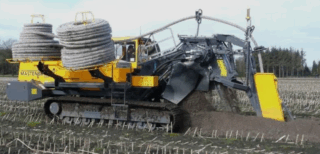


Mastenbroek Limited is a British specialist manufacturer of self-propelled trenchers, drainage plows and associated equipment, with particularly deep roots in agricultural subsurface drainage. The company is headquartered in Boston, Lincolnshire, United Kingdom, in the Fens—one of Britain’s most drainage-dependent and productive agricultural regions.
Mastenbroek’s history in the UK began in 1965, when founder John Mastenbroek started selling and servicing Dutch-manufactured drainage trenchers. Experience in British conditions revealed that existing machines struggled with the country’s heavy soils, leading the company to develop its own equipment. In 1977, Mastenbroek began designing and manufacturing its own drainage trenchers and trenchless plows in Britain. Remarkably, the company’s first production trencher is still reported to be in commercial operation.
Innovation became central to the company’s development. As early as 1973, Mastenbroek incorporated laser transmitter and receiver technology for automatic grade control. It subsequently pioneered large drainage plows, increasingly sophisticated hydrostatic drives and machine-control systems, while expanding from agricultural drainage into utilities, groundwater control, ground stabilisation and subsea trenching.
Today, Mastenbroek remains a privately owned UK manufacturer with a global customer base and support network. Agriculture remains strategically important, but the company’s engineering capabilities now extend well beyond farming.
Corporate Structure / Ownership
Mastenbroek Limited is an independent, privately owned British engineering company headquartered in Boston, Lincolnshire.
The company integrates:
- machine design and engineering
- manufacturing
- hydrostatic systems
- cutting-chain technology
- machine control
- custom engineering
- assembly and testing
- spare parts
- technical and field support
Unlike a conventional agricultural implement company, Mastenbroek designs and manufactures the complete self-propelled power unit and working system, giving it the characteristics of a specialised heavy-equipment OEM.
Core Business & Product Portfolio
Mastenbroek’s portfolio extends across agricultural drainage, utility trenching, rock cutting, groundwater management and subsea applications.
Agricultural Drainage Trenchers
Agriculture remains the company’s historical core.
The current drainage trencher range includes:
- 9/12
- 10/12D
- 15/15
- 20/15
- 30/20
- 40/20
These machines install lateral and collector subsurface drainage systems while maintaining precise depth and grade.
The range extends from relatively compact machines suitable for orchards, glasshouses and sports surfaces to large machines designed for professional drainage contractors.
Mastenbroek 20/15
The 20/15 is one of the company’s most important agricultural machines.
It provides:
- trench depths from 0.4 to 2.0 m
- optional depth to 2.5 m
- trench widths from 132 to 450 mm
- 235 kW / 320 hp Volvo Stage V engine
- independent hydrostatic track drive
- oscillating heavy-duty undercarriage
- elevating ROPS-certified cab
The machine weighs approximately 18.4 tonnes.
The 20/15 is designed for agricultural lateral and collector drainage as well as cross-country applications.
Mastenbroek 30/20
For heavier operations, the 30/20 increases power to 315 kW / 428 hp and can trench to approximately 2.2 metres as standard or 3 metres optionally.
Its dual-speed digging-chain drive is designed to maintain torque across different soil conditions.
Compact Drainage Machines
The 10/12D addresses smaller-scale agricultural drainage and restricted-access applications.
With a 100 kW / 134 hp Cummins engine and approximately 7.5–8.9 tonne operating weight, it can work in:
- orchards
- glasshouses
- sports fields
- smaller agricultural drainage projects.
An offset version allows the trench head to move laterally, enabling drainage installation close to greenhouse structures.
Drainage Plows
Mastenbroek also manufactures dedicated self-propelled drainage plows:
- 25/20 Straight & V
- 40/20 Straight & V
These machines install drainage pipes without excavating a conventional open trench, increasing installation speed where soil conditions permit.
Auxiliary Equipment
The company produces complementary machinery including crawler trucks for transporting and placing gravel or filtration material.
This enables Mastenbroek to provide equipment for the wider drainage installation process rather than simply the trenching operation.
Deep Trenchers
Mastenbroek manufactures:
- 50/50
- 70/80
- SM80
These machines are designed for deeper groundwater-control and soil-engineering applications. They can also mix soil and binder in situ for ground stabilisation and underground structures.
Rock & Utility Trenchers
Outside agriculture, the company manufactures:
- deep trenchers
- rock trenchers
- HRT-series rock trenchers
- utility trenchers
- specialist cutting systems.
These products address energy, infrastructure and utility applications.
Subsea Equipment
Mastenbroek has also transferred its cutting-chain expertise into subsea trenching, developing systems for laying and protecting offshore cables and pipelines.
This gives the company exposure to offshore energy and infrastructure markets in addition to agriculture.
Product Scope Clarification
Mastenbroek manufactures:
- agricultural drainage trenchers
- self-propelled drainage plows
- deep trenchers
- rock trenchers
- utility trenchers
- crawler trucks
- auxiliary drainage equipment
- subsea trenching equipment
- specialised cutting systems
- engineered custom machinery.
Mastenbroek does NOT manufacture:
- tractors
- combines
- forage harvesters
- sprayers
- seed drills
- balers
- telehandlers
- conventional agricultural implements.
Its agricultural specialisation is specifically land drainage and water-management machinery.
Technology & Engineering / Digital Approach
Mastenbroek’s engineering philosophy can be summarised as:
Precision grade control • Hydrostatic engineering • Cutting technology • Heavy-duty durability
Machine control is particularly important because agricultural drainage systems depend on maintaining extremely accurate pipe gradients over considerable distances.
Mastenbroek machines can integrate PTX Trimble laser and GPS technology, including RTK positioning, for accurate depth and grade control.
The technology can support:
- topographic surveying
- drainage design
- automatic grade control
- machine steering
- installation monitoring
- as-installed mapping.
Mastenbroek is also a long-standing PTX Trimble Authorised Dealer for water-management technology.
Farm Works
The company supports Farm Works software for drainage:
Survey → Analysis → Design → Installation → Mapping
This creates a digital workflow connecting field topography with the physical installation of the drainage network.
The combination of software, positioning and machine control makes Mastenbroek substantially more technologically sophisticated than a conventional mechanical drainage-equipment manufacturer.
Manufacturing & Industrial Footprint
Mastenbroek designs and manufactures its machines in Boston, Lincolnshire, UK.
British production began in 1977 and remains central to the company’s identity.
The company’s industrial capabilities include:
- heavy fabrication
- machine assembly
- hydraulic integration
- hydrostatic drivetrain engineering
- cutting-chain systems
- machine-control integration
- customised engineering.
Long machine life is an important part of its market positioning. Mastenbroek highlights that the first machine it manufactured in 1977 remains operational, while the company emphasises durability, component longevity and resale value as part of the total economics of ownership.
Markets & Distribution / Customer Base
Mastenbroek has developed a global customer base, with machines operating across agricultural, utility and infrastructure markets worldwide.
Its agricultural customers primarily include:
- specialist drainage contractors
- large farms
- agricultural infrastructure contractors
- horticultural operations
- sports-turf contractors
- irrigation and water-management specialists.
The UK remains an important market, but Mastenbroek machines operate internationally. For example, New Zealand contractor Awakeri Drainage uses both Mastenbroek 20/15 and CT12 equipment and reported increasing annual pipe installation from approximately 60–70 km to 100–120 km after modernising its machinery fleet.
Strengths & Competitive Advantages
- More than 60 years of drainage-sector experience
- Own trencher manufacturing since 1977
- Deep agricultural drainage expertise
- Complete self-propelled machine engineering
- Strong hydrostatic-drive capabilities
- Advanced cutting-chain technology
- PTX Trimble laser/GPS integration
- Digital drainage design and mapping
- Extremely durable machinery
- Global installed base
- Agricultural, utility and offshore diversification
- Ability to engineer customised solutions
Weaknesses / Constraints
- Highly specialised machinery segment
- Relatively low-volume production
- High capital cost of self-propelled equipment
- Strong dependence on professional contractors
- Agricultural demand influenced by drainage investment cycles
- Limited relevance outside drainage and trenching applications
- Smaller industrial scale than diversified construction-equipment OEMs
- Specialist dealer/service requirements
Its specialisation is simultaneously Mastenbroek’s greatest competitive advantage and its principal limitation.
Outlook & Opportunities
Agricultural drainage is likely to become increasingly important as climate volatility increases.
More frequent periods of:
- intense rainfall
- waterlogging
- drought
- soil degradation
- unpredictable growing conditions
increase the value of controlling water within the soil profile.
Mastenbroek is therefore positioned around an agricultural infrastructure segment that could become strategically more important under climate adaptation.
Another opportunity lies in precision water management. Connecting RTK field surveys, drainage design software and automated machine control makes drainage increasingly data-driven rather than simply an earthmoving operation.
Outside agriculture, energy infrastructure, offshore wind, cable installation and utility development provide significant diversification opportunities.
Summary Table
| Category | Highlights |
|---|---|
| UK Operations Started | 1965 |
| Own Machine Production | 1977 |
| Founder | John Mastenbroek |
| Headquarters | Boston, Lincolnshire, UK |
| Ownership | Private |
| Core Agricultural Business | Subsurface drainage machinery |
| Main Products | Drainage trenchers, drainage plows, crawler trucks |
| Key Models | 9/12, 10/12D, 15/15, 20/15, 30/20, 40/20 |
| Other Activities | Utility, rock, deep and subsea trenching |
| Technology Focus | Hydrostatics, cutting chains, GPS/laser grade control |
| Digital Platform | Farm Works / PTX Trimble integration |
| Manufacturing | Boston, UK |
| Market Presence | Global |
| Competitive Position | Specialist global trenching and drainage-equipment OEM |
Bottom Line
Mastenbroek occupies a highly specialised but strategically important position within agricultural machinery: the mechanisation of subsurface water management.
Its competitive advantage comes from combining almost five decades of self-propelled trencher manufacturing with hydrostatic engineering, cutting-chain technology and increasingly sophisticated digital grade control. The result is not simply a trenching machine but an integrated system capable of moving from field survey and drainage design to precision installation and final mapping.
The company’s diversification into utilities, deep trenching, ground stabilisation and subsea applications also gives it a broader technological base than its agricultural origins might suggest.
Most importantly for agriculture, drainage could become more—not less—strategically relevant as extreme rainfall and climate variability increase. Mastenbroek therefore operates in a small machinery niche whose importance to agricultural productivity may progressively grow.