

Overview & History
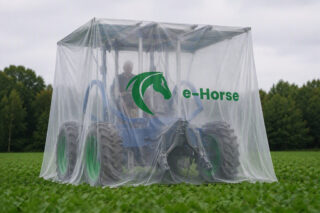
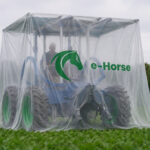
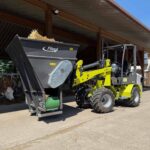
e-Horse is a Dutch agricultural technology project focused on the development of a lightweight fully electric implement-carrier tractor, engineered and manufactured by Machinefabriek Boessenkool B.V. in Almelo, Overijssel, Netherlands. The project combines Boessenkool’s engineering and manufacturing capabilities with the original concept developed by Dutch arable farmer and plant grower Bastian van der Veen.
The industrial background behind e-Horse is considerably older than the tractor project itself. Machinefabriek Boessenkool was founded in 1902 and has developed into a specialist engineering company capable of designing and manufacturing complex machinery for agriculture, energy, recycling and other industrial applications.
The e-Horse project originated when Van der Veen approached Boessenkool in 2021 with the idea of developing an electric implement carrier for crop-care operations. Boessenkool had already gained experience with alternative tractor concepts through the earlier MultiToolTrac project. The resulting e-Horse prototype entered significant field testing in 2023, particularly for mechanical hoeing.
Today, e-Horse is positioned as a specialised electric tractor/tool-carrier platform aimed primarily at crop-care operations where low machine weight, manoeuvrability and zero local emissions offer advantages over conventional tractors.
Corporate Structure / Ownership
e-Horse operates within the industrial ecosystem of Machinefabriek Boessenkool and the wider Osse Equipment Manufacturing Group.
The group includes businesses such as:
- Machinefabriek Boessenkool
- e-Horse
- DESPRAY Environmental
- Drone4
The common strategic themes are engineering, electrification, renewable energy and circular-economy technologies.
e-Horse itself is described as a privately held company based in Almelo, founded in 2016, with its activity classified as agricultural, construction and mining machinery manufacturing.
Machinefabriek Boessenkool provides the engineering and industrial capabilities required to transform the agricultural concept into a manufacturable vehicle.
Core Business & Product Portfolio
The company’s agricultural activity currently revolves around the e-Horse electric implement carrier.
e-Horse Electric Tractor / Tool Carrier
The e-Horse is deliberately different from a conventional tractor.
Its design priorities are:
- low machine weight
- fully electric propulsion
- low soil compaction
- four-wheel drive
- four-wheel steering
- high manoeuvrability
- implement visibility
- low energy consumption
- zero local exhaust emissions
The machine is particularly intended for crop-care operations rather than heavy primary tillage.
Typical applications include:
- mechanical hoeing
- inter-row cultivation
- light seeding
- harrowing
- crop maintenance
- other lightweight implement operations
The machine can work with implements approximately 3 metres wide.
Electric Powertrain
The e-Horse uses a 20 kWh lithium-ion battery combined with solar panels mounted above the operator.
Each wheel is driven by an individual 48-volt electric wheel motor, providing permanent four-wheel drive.
Reported performance includes:
- 20 kWh battery
- eight roof-mounted solar panels
- permanent four-wheel drive
- four-wheel steering
- maximum road speed around 13 km/h
- working speed up to approximately 8 km/h
- 6–8 hours operating capability depending on conditions
The vehicle was intentionally designed to minimise energy consumption rather than compensate for high energy demand with a very large battery.
Solar Integration
Solar generation is one of the most distinctive features of e-Horse.
The large roof structure carries photovoltaic panels that supplement battery energy during field operations. Under favourable operating conditions, the combination of battery capacity and solar generation has demonstrated sufficient energy for approximately six to eight hours of work.
The solar system should therefore be understood primarily as an energy-extending architecture, rather than assuming the tractor operates exclusively from instantaneous solar power.
Hydrogen Range Extender
An important subsequent development has been a hydrogen fuel-cell range extender.
In 2025, Boessenkool presented a roughly 160 kg hydrogen generator module incorporating:
- fuel cell
- cooling system
- inverter
- hydrogen storage
When battery charge becomes depleted, the fuel cell automatically generates electricity to recharge/support the vehicle’s battery system.
This creates an unusual multi-energy architecture:
Battery electric + solar generation + optional hydrogen range extension.
Product Scope Clarification
e-Horse develops/manufactures:
- electric agricultural implement carriers
- electric tractor platforms
- solar-assisted agricultural vehicles
- electric drivetrains
- crop-care machinery platforms
- hydrogen range-extension technology
e-Horse does NOT currently manufacture a broad range of:
- conventional diesel tractors
- combines
- forage harvesters
- sprayers
- balers
- telehandlers
- large tillage implements
- diesel engines
Its industrial focus is lightweight alternative-energy agricultural power units.
Technology & Engineering / Digital Approach
The engineering philosophy behind e-Horse can be summarised as:
Low weight • Low energy demand • Electrification • Soil protection
This is important because e-Horse approaches tractor electrification differently from manufacturers attempting to replace a conventional diesel tractor with a similarly sized battery-electric machine.
Instead, the designers first reduced the vehicle’s weight and power requirements and then designed the electric architecture around those lower energy requirements.
Another unusual characteristic is the extensive elimination of hydraulics. The drivetrain, steering and lifting functions are electrically operated, with reports indicating that essentially the only oil required by the vehicle is within the wheel-motor gearboxes.
Four-wheel steering provides high manoeuvrability, while the control strategy can behave more conventionally during hoeing operations, helping maintain accurate implement positioning.
The project’s innovation therefore lies less in digital precision agriculture than in rethinking the physical architecture of the agricultural tractor around electrification.
Manufacturing & Industrial Footprint
Development and manufacturing are centred at Machinefabriek Boessenkool in Almelo, Netherlands.
Boessenkool provides the project with capabilities in:
- mechanical engineering
- electrical engineering
- machine construction
- fabrication
- prototyping
- system integration
- testing
This industrial backing differentiates e-Horse from many early-stage agricultural robotics or electric-tractor start-ups that depend heavily on outsourced manufacturing.
The project remains relatively small-scale, however, and should currently be regarded as an emerging specialised tractor platform rather than a volume tractor OEM.
Markets & Distribution / Customer Base
The principal target customers are:
- arable farms
- vegetable growers
- organic farms
- plant and nursery operations
- specialty-crop growers
- farms practising mechanical weed control
The Netherlands is the project’s natural initial market because intensive crop production, high land values and increasing environmental restrictions create favourable conditions for lightweight electric machinery.
The concept could also have relevance across other European markets characterised by:
- high-value crops
- controlled traffic
- mechanical weeding
- low-emission requirements
- frequent crop-care operations
International commercial scale remains limited compared with established tractor manufacturers.
Strengths & Competitive Advantages
- Fully electric agricultural platform
- Extremely low-energy design philosophy
- Low soil-compaction potential
- Four-wheel drive
- Four-wheel steering
- Solar-assisted operation
- 6–8 hour demonstrated operating potential
- Minimal hydraulic systems
- Strong engineering backing from Boessenkool
- Optional hydrogen range-extension concept
- Well suited to mechanical weed control
Weaknesses / Constraints
- Very small industrial scale
- Limited commercial installed base
- Narrow current application range
- Not suitable for heavy draft operations
- Low maximum speed
- Limited dealer and service infrastructure
- Commercial economics still need validation at scale
- Solar contribution depends on operating conditions
- Strong competition from conventional compact tractors and emerging electric/autonomous platforms
Outlook & Opportunities
e-Horse addresses several important structural trends in European agriculture:
- tractor electrification
- soil-compaction reduction
- mechanical weed control
- lower pesticide use
- zero-emission machinery
- renewable on-farm energy
- specialised crop-care platforms
Its strongest opportunity may not be to replace the conventional tractor entirely.
Instead, e-Horse could establish a new category of secondary farm power unit dedicated to repetitive, relatively low-energy operations such as hoeing, crop inspection, light seeding and inter-row cultivation.
The hydrogen range extender adds another potential pathway by addressing one of battery-electric agriculture’s main constraints: operating duration when charging infrastructure or downtime is limited.
Summary Table
| Category | Highlights |
|---|---|
| Company / Project | e-Horse |
| Industrial Partner | Machinefabriek Boessenkool |
| Location | Almelo, Netherlands |
| Group | Osse Equipment Manufacturing Group |
| Core Business | Electric agricultural implement carrier |
| Main Product | e-Horse |
| Battery | 20 kWh lithium-ion |
| Energy | Battery + solar; hydrogen range extender developed |
| Drive | Individual 48V electric wheel motors |
| Steering | Four-wheel steering |
| Operating Time | Approx. 6–8 hours depending on conditions |
| Primary Applications | Hoeing and crop-care operations |
| Competitive Position | Emerging specialist electric tractor/tool-carrier platform |
Bottom Line
e-Horse is particularly interesting because it does not simply electrify the architecture of a conventional tractor.
The project starts from the opposite direction: minimise weight and energy demand first, then build the power unit around a relatively small battery, individual electric wheel drives and supplementary solar generation. The result is a machine specifically optimised for crop-care operations rather than an attempt to perform every task traditionally assigned to a diesel tractor.
Boessenkool’s industrial involvement is another important differentiator. e-Horse is backed by a Dutch engineering manufacturer with roots dating to 1902, rather than being solely a venture-funded software or robotics project.
Its commercial scale remains small, but the concept provides an interesting alternative vision for tractor electrification: lighter machines, smaller batteries and task-specific power platforms rather than ever-larger electric replacements for conventional tractors.