

1. Overview & History
AIgro B.V. is a Dutch agricultural robotics company headquartered in Best, North Brabant, specialising in compact autonomous electric machines for crop maintenance, mechanical weed control and vegetation management.
Founded in 2019 by Peter Brier, the company emerged from the Dutch Brainport technology ecosystem around Eindhoven, an industrial region internationally recognised for its expertise in robotics, electronics, mechatronics and advanced engineering.
Brier’s professional background in high-technology industries provided the foundation for applying autonomous navigation and intelligent sensing to agricultural machinery.
AIgro initially concentrated on tree nurseries, where repetitive maintenance operations, labour requirements and narrow working spaces create opportunities for compact autonomous equipment.
The company subsequently expanded its technological focus to orchards, vineyards, soft-fruit production and other agricultural environments characterised by structured planting arrangements.
Its flagship product, the AIgro UP, is an autonomous electric implement carrier designed to perform multiple crop-maintenance operations using interchangeable tools.
The robot was publicly introduced in 2021, with commercial availability following in 2022.
By 2025–2026, AIgro had progressed from early technology development into commercial deployment, with machines operating on dozens of farms across Europe and an expanding distribution structure.
Its industrial strategy is based on making agricultural autonomy accessible through relatively compact, versatile and mechanically straightforward machines.
2. Corporate Structure & Management
AIgro operates as AIgro B.V., a privately held Dutch limited liability company.
Its registered business address is Hagelaarweg 25, 5684 NW Best, Netherlands.
The company is registered with the Dutch Chamber of Commerce under number 75303973.
The management structure combines agricultural sector experience with expertise in robotics, software and mechanical engineering.
| Executive | Position | Principal responsibility |
|---|---|---|
| Peter Brier | Founder | Original technological and entrepreneurial development |
| Wim Reijersen van Buuren | CEO | Corporate management and commercial expansion |
| Rob Jansen | COO | Mechanical engineering and operations |
| Loy van Beek | Lead Software Developer | Robotics software and automation |
| Sven Bressers | Technical Lead | Technology development and engineering |
Wim Reijersen van Buuren became CEO in 2024, bringing more than three decades of agricultural sector experience.
This management transition is strategically important because commercialising agricultural robotics requires capabilities beyond technology development, including distribution, customer support and equipment reliability.
Detailed shareholder information and the company’s financing structure are not sufficiently established to describe its ownership beyond its private corporate status.
3. Core Business & Product Portfolio
AIgro concentrates on the development and manufacture of autonomous electric implement carriers.
Unlike agricultural robotics companies developing separate machines for individual tasks, AIgro uses a multifunctional platform architecture.
Its principal machine, AIgro UP, can be equipped with different implements depending on the agricultural operation.
| Product / technology | Principal application |
|---|---|
| AIgro UP | Autonomous electric implement carrier |
| Mowing attachment | Grass and vegetation management |
| Swing mower | Vegetation control around plants and trees |
| Mechanical hoe | Inter-row weed removal |
| Harrow attachment | Shallow soil and weed management |
| Autonomous navigation system | Crop-row recognition and machine guidance |
| Exchangeable battery system | Extended operating availability |
| Digital operating application | Machine monitoring and user interaction |
| Custom implements | Additional customer-specific applications |
The company’s product philosophy is based on separating the autonomous mobile platform from the implement performing the agricultural task.
This allows growers to use the same robotic machine for different operations during the growing season.
The approach can improve equipment utilisation and reduce the need to purchase several specialised robots.
4. AIgro UP – Autonomous Electric Implement Carrier
The AIgro UP is the company’s principal commercial product.
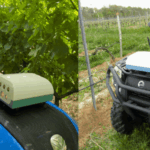
It is a compact, battery-powered autonomous machine designed to travel through crop rows and perform repetitive maintenance operations without continuous direct driving by an operator.
Its small dimensions allow operation in environments where conventional tractors or larger autonomous machines may be unsuitable.
The platform is particularly relevant to tree nurseries, vineyards and orchards, where crop rows create a relatively structured operating environment.
AIgro UP is available in three principal configurations.
| Configuration | Machine width | Drive system |
|---|---|---|
| AIgro UP 2WD | 55 cm | Two-wheel drive |
| AIgro UP 4WD Compact | 55 cm | Four-wheel drive |
| AIgro UP 4WD Wide | 75 cm | Four-wheel drive |
The availability of two- and four-wheel-drive versions allows the platform to address different terrain and traction requirements.
Its compact architecture is designed to minimise soil disturbance while maintaining sufficient capability for mowing and mechanical weeding.
The company has developed the platform around robustness, ease of maintenance and practical agricultural operation rather than maximum vehicle power.
5. Technical Specifications & Operating Characteristics
AIgro UP combines electric propulsion, interchangeable batteries, autonomous navigation and modular implement integration.
| Specification | AIgro UP |
|---|---|
| Machine type | Autonomous electric implement carrier |
| Propulsion | Battery-electric |
| Drive configurations | 2WD and 4WD |
| Available machine widths | 55 cm and 75 cm |
| Approximate height | 61 cm |
| Maximum documented length | Approximately 185 cm |
| Mower working widths | 60–100 cm |
| Main guidance technology | Sensors, computer vision and navigation algorithms |
| GPS function | Navigation between rows and fields |
| Energy system | Exchangeable batteries |
| Reported operating duration | Approximately 8 hours per battery configuration |
| Extended operating potential | Up to 24 hours/day with battery exchanges |
| Principal operations | Mowing, hoeing and harrowing |
| Operator interface | Digital application |
The dimensions and operating duration describe documented configurations and may vary according to machine version, attached implement and working conditions.
The distinction between battery endurance and total daily operating time is important.
AIgro’s reference to 24-hour operation does not imply that a single battery charge provides 24 hours of continuous autonomy.
Rather, extended operation is made possible by replacing depleted batteries with charged units.
This approach reduces the need for the robot to remain inactive while connected to a charging station.
6. Autonomous Navigation & Sensor Technology
AIgro’s most important technological differentiation is its navigation architecture.
Many agricultural autonomous machines depend heavily on satellite positioning and RTK corrections to follow predetermined routes.
AIgro uses a different approach.
Its machines rely primarily on onboard sensors, computer vision and proprietary navigation algorithms to recognise crop rows and navigate within them.
GPS is used principally for transitions between rows and fields.
This architecture is particularly relevant to tree nurseries and orchards, where dense vegetation can interfere with satellite reception.
Navigation architecture
| Technology | Function |
|---|---|
| Onboard sensors | Detect surrounding structures and operating conditions |
| Computer vision | Recognise plants and crop-row geometry |
| Navigation algorithms | Determine the machine’s operating path |
| GPS positioning | Support transitions between rows and fields |
| Digital application | Allow operators to monitor and manage the robot |
The ability to navigate beneath dense foliage without continuous dependence on high-quality satellite positioning is an important competitive characteristic.
However, autonomous navigation should not be confused with unrestricted operation in every agricultural environment.
Machine performance remains dependent on crop structure, terrain, visibility, obstacles and the suitability of the operating area.
AIgro’s principal technological achievement is the development of a navigation system adapted to relatively structured agricultural environments.
7. Mechanical Weed Control
Mechanical weeding is one of AIgro’s principal agricultural applications.
The company develops tools capable of removing unwanted vegetation without relying on herbicide application.
Its mechanical hoe and harrow attachments are intended for use between crop rows and in other accessible areas.
This technology addresses several agricultural challenges.
First, weed control is a recurring labour-intensive operation, particularly in nurseries and perennial crops.
Second, growers increasingly face pressure to reduce chemical inputs and manage herbicide resistance.
Third, mechanical weed control can support organic production systems where synthetic herbicide use is restricted.
AIgro’s approach is based on automating relatively frequent, low-intensity interventions rather than relying exclusively on occasional operations using larger machines.
This can create opportunities to maintain weed populations at lower levels through repeated treatments.
The company’s competitive proposition therefore extends beyond labour substitution.
It also concerns the possibility of changing the timing and frequency of crop-maintenance operations.
8. Autonomous Mowing & Vegetation Management
Mowing represents another important application of the AIgro UP platform.
The machine can operate with mower attachments offering working widths of approximately 60–100 cm.
A swing-mower configuration provides additional flexibility when managing vegetation around trees or other planted structures.
This is particularly relevant to tree nurseries and orchards, where vegetation must be controlled without damaging valuable plants.
Traditional mowing may require a tractor, an operator and specialised attachments.
AIgro seeks to perform these repetitive operations using a smaller autonomous machine.
The potential benefits include reduced operator hours, lower local emissions and more frequent maintenance.
The machine’s relatively low mass may also reduce soil compaction compared with larger conventional equipment, although actual effects depend on soil conditions and the machinery being replaced.
9. Agricultural Applications
AIgro has developed its platform for several agricultural and horticultural environments.
| Application | Principal operations | Commercial relevance |
|---|---|---|
| Tree nurseries | Mowing and mechanical weeding | Core established market |
| Orchards | Inter-row maintenance and vegetation management | Established application |
| Vineyards | Mowing and weed management | Established application |
| Soft-fruit production | Crop-row and vegetation maintenance | Developing market |
| Elevated strawberry systems | Maintenance beneath growing structures | Specialised application |
| Open-field horticulture | Mechanical crop maintenance | Development and testing |
| Plant nurseries | Autonomous vegetation management | Potential expansion |
| Solar parks and golf courses | Vegetation maintenance | Non-agricultural diversification |
Tree nurseries remain particularly important to the company’s positioning.
Their regular planting geometry, repeated maintenance requirements and high labour costs create favourable conditions for autonomous operation.
The platform’s small dimensions also create opportunities in elevated strawberry production, where access beneath growing structures may be difficult for conventional machinery.
However, the company’s presence in different applications should not be interpreted as evidence that every operating environment has reached the same level of commercial maturity.
10. Commercial Deployment & Customer Experience
AIgro has progressed beyond the prototype stage and reports machines operating on dozens of farms across Europe.
A documented customer is Boot & Dart Boomkwekerijen, a Dutch tree nursery business.
The company uses AIgro equipment for regular mowing and mechanical weed control between trees.
Its experience illustrates the practical operating model.
Rather than requiring an employee to drive a tractor continuously, a worker prepares and starts the autonomous machine, which then performs the assigned maintenance operation.
The customer has highlighted equipment flexibility and technical support as important advantages.
This case is commercially significant because it demonstrates adoption within an established agricultural business rather than only experimental testing.
Nevertheless, individual customer experiences should not be interpreted as universal evidence of labour savings or financial returns.
The economic benefit depends on field layout, machine utilisation, operator requirements, maintenance costs and the number of operations performed annually.
11. Manufacturing & Technology Development
AIgro’s principal engineering and development operations are based in Best, near Eindhoven.
The company operates within a regional technology ecosystem with strong expertise in robotics, mechatronics and electronic systems.
Its documented capabilities include:
- autonomous mobile robotics;
- mechanical engineering;
- sensor integration;
- computer vision;
- navigation software;
- electric machine architecture;
- application and cloud software;
- agricultural equipment testing;
- product integration and technical support.
AIgro develops and builds its autonomous implement carriers, combining proprietary software with mechanical and electronic systems.
Its business model is focused on specialised robotics rather than conventional agricultural machinery manufacturing.
The company does not publicly establish large-scale factory capacity, annual production volumes or the degree to which individual components are manufactured internally.
Its principal industrial challenge is to convert relatively small-series robotic production into a repeatable manufacturing and support model capable of serving a wider European market.
12. Markets & Distribution
The Netherlands is AIgro’s home market and an important centre of its commercial development.
The company has also established customers in other European countries.
A significant commercial milestone occurred in May 2025, when Dutch agricultural machinery distributor Mechan became a distribution partner for AIgro.
The agreement allows AIgro to benefit from an established agricultural equipment distribution organisation while concentrating its own resources on product development.
Mechan’s involvement is strategically relevant because agricultural robots require more than a sales channel.
Customers also need installation support, training, maintenance, spare parts and technical assistance.
AIgro’s expansion therefore depends on developing distribution capabilities appropriate to agricultural machinery rather than relying exclusively on direct technology sales.
In 2025, the AIgro UP was reported with a starting price of approximately €40,000, depending on configuration.
This is a historical market indication, not a verified current list price.
The economic attractiveness of the machine depends heavily on utilisation, particularly the number of operating hours and tasks performed throughout the year.
13. Product Scope Clarification
AIgro develops and manufactures:
- autonomous electric implement carriers;
- compact agricultural field robots;
- autonomous navigation software;
- crop-row recognition systems;
- interchangeable mowing equipment;
- mechanical weeding attachments;
- harrowing attachments;
- battery-powered robotic platforms;
- digital machine-monitoring applications;
- customer-specific robotic implement integrations.
AIgro does not have an established manufacturing position in:
- conventional agricultural tractors;
- combine harvesters;
- forage harvesters;
- conventional self-propelled sprayers;
- seed drills;
- balers;
- telehandlers;
- agricultural engines;
- autonomous fruit-picking robots.
Its principal industrial identity is autonomous electric crop-maintenance equipment, with a particular emphasis on mechanical weed control and mowing.
14. Strengths & Competitive Advantages
AIgro’s competitive position is supported by several characteristics.
- Specialisation in compact autonomous agricultural machinery.
- Development within the Eindhoven high-technology ecosystem.
- Sensor-based navigation with limited dependence on GPS.
- Ability to operate beneath dense foliage.
- Compact dimensions suitable for narrow crop rows.
- Battery-electric propulsion.
- Exchangeable batteries for extended operation.
- Multifunctional implement architecture.
- Applications across several horticultural sectors.
- Commercial experience in tree nurseries.
- Established distribution partnership with Mechan.
- Direct collaboration with agricultural customers.
- Potential to reduce repetitive labour requirements.
Its strongest advantage is the combination of compact autonomous navigation and interchangeable agricultural implements.
This allows the company to address several recurring maintenance operations using a common robotic platform.
15. Weaknesses & Constraints
AIgro also faces structural challenges typical of emerging agricultural robotics manufacturers.
Its relatively small industrial scale limits the resources available for simultaneous investment in software, mechanical engineering, manufacturing and international distribution.
Agricultural robots also face demanding operating conditions, including mud, uneven terrain, vegetation, obstacles and changing weather.
Additional constraints include:
- significant initial investment relative to conventional compact equipment;
- dependence on sufficient annual machine utilisation;
- limited independently verified fleet and revenue information;
- need for a reliable service network;
- battery logistics and operating endurance;
- varying suitability across crop structures;
- competition from other autonomous mowing and weeding systems;
- the challenge of expanding beyond structured perennial crops.
A further consideration is the difference between technical autonomy and complete labour independence.
Although the robot can perform field operations without continuous driving, personnel are still required for preparation, supervision, battery changes, transport and certain interventions.
The economic case must therefore be evaluated against the total operating process rather than assuming that all associated labour disappears.
16. Outlook & Opportunities
AIgro’s future development is closely connected to the adoption of autonomous crop-maintenance machinery in European horticulture.
Three opportunities are particularly important.
Expansion within perennial crops. Tree nurseries, orchards and vineyards offer recurring maintenance requirements and relatively structured operating environments.
Greater machine utilisation. Additional compatible implements could allow a single AIgro UP to perform more tasks throughout the growing season, improving the economics of ownership.
International distribution. A stronger dealer network could accelerate commercial adoption while improving technical support and customer confidence.
The company’s navigation architecture may also provide opportunities in environments where satellite-based positioning is unreliable.
However, its long-term competitiveness will depend on maintaining mechanical reliability, reducing operational complexity and demonstrating attractive financial returns.
The transition from a technology-led start-up to an established machinery supplier will require consistent product quality, scalable manufacturing and dependable after-sales service.
Summary Table
| Category | Highlights |
|---|---|
| Company | AIgro B.V. |
| Founded | 2019 |
| Founder | Peter Brier |
| Headquarters | Best, North Brabant, Netherlands |
| Ownership | Private |
| CEO | Wim Reijersen van Buuren |
| Core Business | Autonomous agricultural robotics |
| Flagship Product | AIgro UP |
| Machine Type | Autonomous electric implement carrier |
| Drive Configurations | 2WD and 4WD |
| Machine Widths | 55 cm and 75 cm |
| Main Operations | Mowing, hoeing and harrowing |
| Navigation | Sensor-based, computer vision, GPS-assisted transitions |
| Powertrain | Battery-electric |
| Battery System | Exchangeable batteries |
| Principal Markets | Tree nurseries, orchards and vineyards |
| Commercial Presence | Netherlands and other European markets |
| Distribution Partner | Mechan |
| Reported Deployment | Dozens of farms across Europe |
| Strategic Position | Autonomous Crop Maintenance & Mechanical Weed Control |
Bottom Line
AIgro represents a distinctive approach to agricultural robotics based on compact, multifunctional autonomous machines rather than large robotic replacements for conventional tractors.
Its flagship AIgro UP is designed to automate repetitive crop-maintenance operations such as mowing and mechanical weed control, particularly in tree nurseries, orchards and vineyards.
The company’s technological differentiation lies in its navigation system, which combines onboard sensors and computer vision with limited reliance on GPS. This architecture addresses the practical challenges of operating beneath dense vegetation and within narrow crop rows.
Its interchangeable implement system is equally important. By allowing one robotic platform to perform several agricultural tasks, AIgro seeks to improve equipment utilisation and strengthen the economic case for autonomy.
The company’s commercial deployment and distribution partnership with Mechan indicate progress beyond initial technology validation.
Nevertheless, its future competitiveness will depend on demonstrating consistent reliability, attractive operating economics and the ability to support customers across a growing geographic market.
AIgro’s industrial significance lies in showing how autonomous technology can be introduced into agriculture through smaller, task-oriented machines capable of operating alongside existing equipment fleets.
Strategic Position
Industrial Layer: Autonomous Electric Implement Carriers, Mechanical Weed Control & Precision Crop Maintenance
AIgro operates within an emerging agricultural machinery segment characterised by the progressive automation of repetitive field operations.
Its technological development can be summarised as:
Compact Electric Mobility → Autonomous Row Navigation → Interchangeable Implements → Continuous Crop Maintenance
The company’s approach differs from that of manufacturers developing large autonomous tractors or dedicated single-task robots.
AIgro concentrates on a relatively small mobile platform capable of performing several maintenance operations in structured agricultural environments.
This positioning has two important industrial implications.
First, autonomous machinery does not necessarily need to replace conventional tractors across all agricultural operations. Smaller robotic platforms can complement existing equipment by taking over repetitive, lower-power tasks.
Second, the economic value of autonomy increasingly depends on machine utilisation rather than autonomy alone.
A multifunctional robot capable of mowing, hoeing and performing other maintenance operations may offer a stronger investment case than a dedicated machine operating only during a short seasonal window.
AIgro’s longer-term competitive position will therefore depend on expanding the practical capabilities of its platform while maintaining the simplicity, reliability and affordability that underpin its commercial proposition.
The broader strategic significance of AIgro is its contribution to a more distributed model of agricultural mechanisation, in which compact autonomous machines progressively assume routine crop-maintenance tasks while conventional equipment remains responsible for heavier agricultural operations.